CREATE2
CREATE2 is a new opcode introduced in Ethereum's "Constantinople" hard fork upgrade. Unlike CREATE, it uses a new method to calculate contract addresses, making the generated contract addresses more controllable. Through CREATE2, many interesting techniques can be derived. In CTF competitions, the most common use is leveraging this controllability to deploy contracts with completely different bytecode at the same address sequentially.
Principle
CREATE
If an external account or a contract account using the CREATE opcode creates a contract, it is easy to determine the address of the created contract. Each account has an associated nonce: for external accounts, the nonce increments by 1 with each transaction sent; for contract accounts, the nonce increments by 1 with each contract created. The new contract's address is calculated from the sender account address of the contract creation transaction and its nonce value, with the specific formula as follows:
keccak256(rlp.encode(address, nonce))[12:]
CREATE2
Unlike the original CREATE opcode, in the method of calculating the contract address, CREATE2 no longer depends on the account's nonce. Instead, it hashes the following parameters to derive the new address:
- The address of the contract creator (
address) - A salt value passed as a parameter (
salt) - The contract creation code (
init_code)
The specific calculation formula is as follows:
keccak256(0xff ++ address ++ salt ++ keccak256(init_code))[12:]
An important detail to note is that the last parameter needed to calculate the contract address is not the contract code itself, but its creation code. This code is used to create the contract, and after the contract is created, it returns the runtime bytecode.
This means that if we control the contract's creation code and keep it unchanged, then control the runtime bytecode returned by the contract constructor, we can easily deploy completely different contracts at the same address repeatedly. In fact, this characteristic of CREATE2 that allows contracts to be re-deployed after deployment poses potential security concerns, which has sparked discussion.
In CTF competitions, this characteristic is often used as a technique to bypass different validations by deploying different contracts at the same address.
Example
Using the PoC provided in the writeup for Creativity from the 2019 Balsn CTF as an example to explain the clever use of CREATE2:
pragma solidity ^0.5.10;

contract Deployer {
    bytes public deployBytecode;
    address public deployedAddr;

    function deploy(bytes memory code) public {
        deployBytecode = code;
        address a;
        // Compile Dumper to get this bytecode
        bytes memory dumperBytecode = hex'6080604052348015600f57600080fd5b50600033905060608173ffffffffffffffffffffffffffffffffffffffff166331d191666040518163ffffffff1660e01b815260040160006040518083038186803b158015605c57600080fd5b505afa158015606f573d6000803e3d6000fd5b505050506040513d6000823e3d601f19601f820116820180604052506020811015609857600080fd5b81019080805164010000000081111560af57600080fd5b8281019050602081018481111560c457600080fd5b815185600182028301116401000000008211171560e057600080fd5b50509291905050509050805160208201f3fe';
        assembly {
            a := create2(callvalue, add(0x20, dumperBytecode), mload(dumperBytecode), 0x9453)
        }
        deployedAddr = a;
    }
}

contract Dumper {
    constructor() public {
        Deployer dp = Deployer(msg.sender);
        bytes memory bytecode = dp.deployBytecode();
        assembly {
            return (add(bytecode, 0x20), mload(bytecode))
        }
    }
}
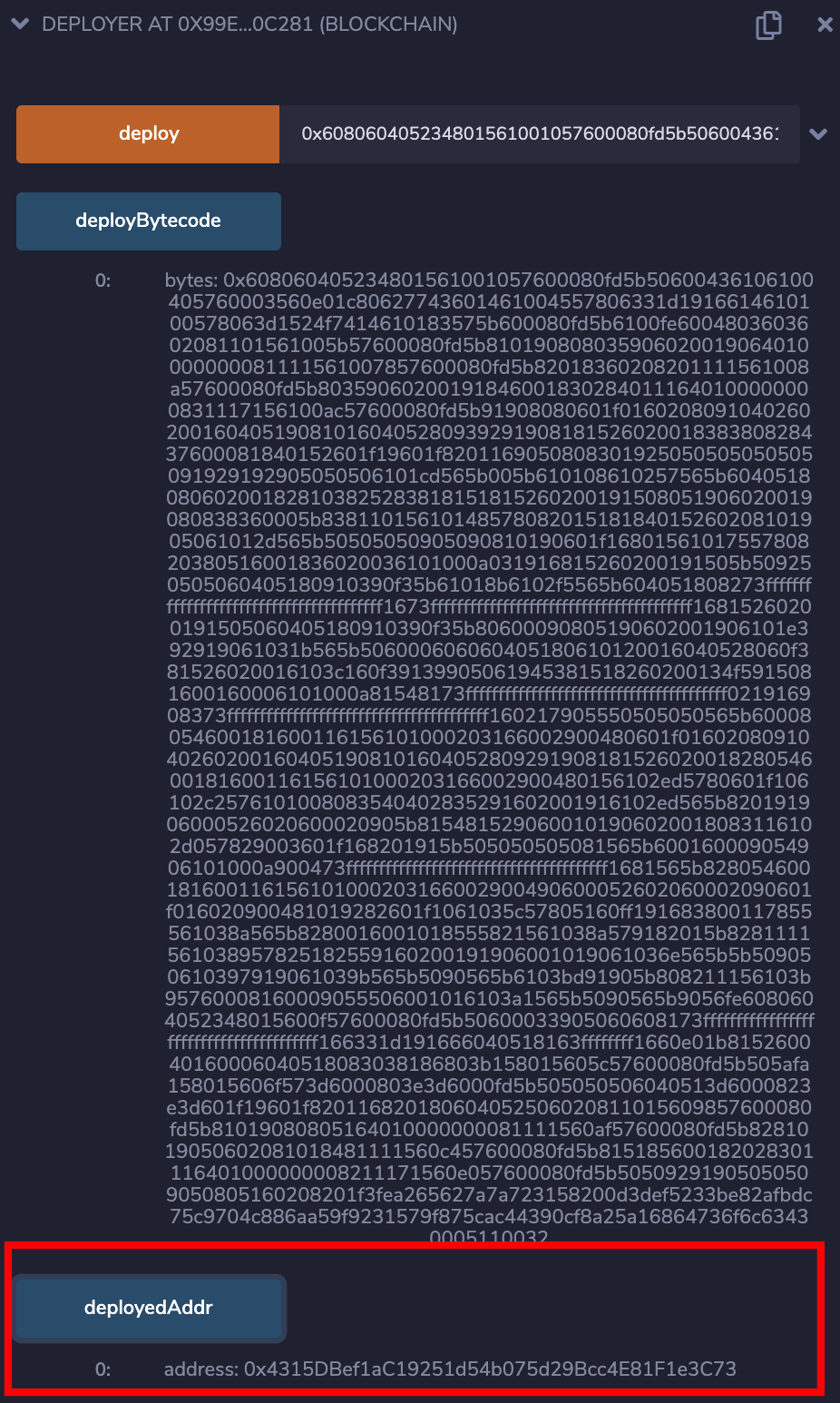
Every time we use the deploy(code) function to deploy a pre-constructed contract, since the actual init_code is always the same dumperBytecode, combined with a fixed contract address and salt, the contract deployed through deploy(code) will always end up at the same address. The loaded contract, during constructor execution, jumps to the code passed in the function call, so no matter what contract we deploy with the deploy(code) function, it will always be deployed to the same address.
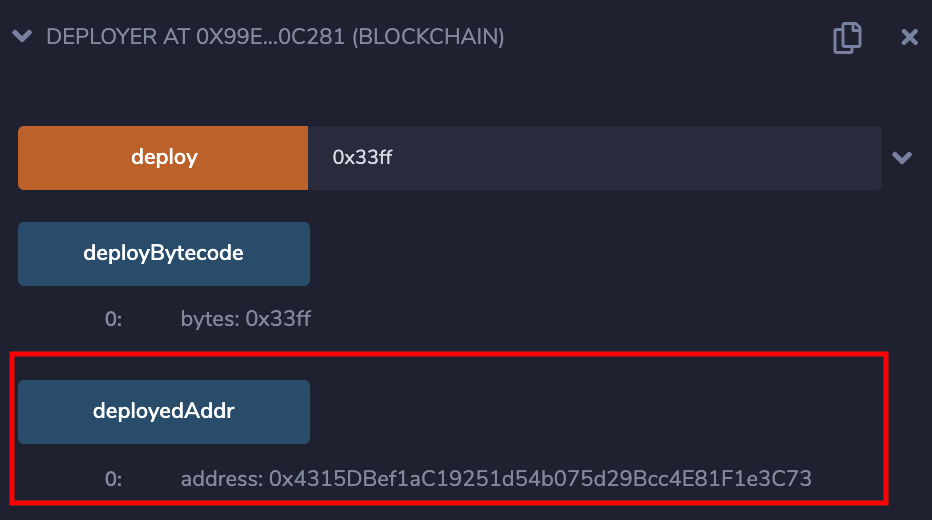
Knowing that the Deployer contract address is 0x99Ed0b4646a5F4Ee0877B8341E9629e4BF30c281, we can calculate the deployed contract's address as 0x4315DBef1aC19251d54b075d29Bcc4E81F1e3C73:
function getAddress(address addr, bytes memory bytecode, uint salt) public view returns (address) {
    bytes32 hash = keccak256(
        abi.encodePacked(
            bytes1(0xff),
            addr,
            salt,
            keccak256(bytecode)
        )
    );

    // NOTE: cast last 20 bytes of hash to address
    return address(uint160(uint256(hash)));
}
Using this contract, we successfully deployed two different contracts at the same address sequentially:
Challenges
Balsn 2019
- Challenge Name: Creativity
QWB 2020
- Challenge Name: EasyAssembly