CVP
CVP is a particularly important problem in lattice-based cryptography.
The basic definition of the problem is as follows: given a basis of a lattice L and a vector \mathbf{v}, find the closest vector to \mathbf{v} in L.
Algorithms
Babai's nearest plane algorithm
This algorithm takes as input a basis B of a lattice L (of rank n) and a target vector \mathbf{t}, and outputs an approximate solution to the CVP problem.
- The approximation factor is \gamma = 2^{\frac{n}{2}}
The specific algorithm:
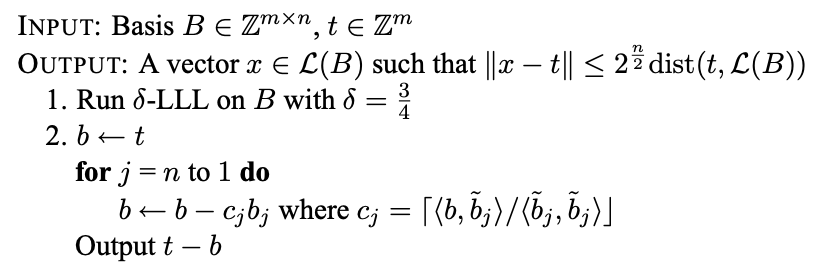
- Here c_j is the rounding of the coefficient in Gram-Schmidt orthogonalization, i.e., the rounding of proj_{b_{j}}(b).
My personal understanding of the second step of this algorithm: find a linear combination in the basis B after lattice basis reduction and orthogonalization that is closest to \mathbf{t}.
Babai's Rounding Technique
This algorithm is a variant of Babai's nearest plane algorithm.
The steps can be expressed as:
N = rank(B), w = target
- B' = LLL(B)
- Find a linear combination [l_0, ... l_N] such that w = sum(l_i * b'_i).
* (b'_i is the i-th vector in the LLL-reduced basis B')
- Round each l_i to it's closest integer l'_i.
- Result v = sum(l'_i * b'_i)
Related Topics
Hidden number problem
The definition of HNP is as follows:
Given a prime p, many t \in \mathbb{F}_p, and each corresponding MSB_{l,p}(\alpha t), find the corresponding \alpha.
- MSB_{l,p}(x) denotes any integer u satisfying \lvert (x \mod p) - u \rvert \le \frac{p}{2^{l+1}}, which approximately takes the l most significant bits of x \mod p.
According to the description in Reference 3, when l \approx \log^{\frac{1}{2}}{p}, the following algorithm can solve HNP:
We can transform this problem into a CVP problem on a lattice generated by the following matrix:
\left[ \begin{matrix} p & 0 & \dots & 0 & 0 \\ 0 & p & \ddots & \vdots & \vdots \\ \vdots & \ddots & \ddots & 0 & \vdots \\ 0 & 0 & \dots & p & 0 \\ t_1 & t_2 & \dots & t_{n} & \frac{1}{2^{l+1}} \end{matrix} \right]
We need to find the vector on the lattice closest to \mathbf{u}=(u_1, u_2, \dots, u_{n}, 0), so here we can use Babai's nearest plane algorithm. Ultimately we can obtain a vector \mathbf{v}=(\alpha \cdot t_1 \mod p, \alpha \cdot t_2 \mod p, \dots, \frac{\alpha}{2^{l+1}}), from which we can compute \alpha.
BCTF 2018 - guess_number
The problem provides server-side code:
import random, sys
from flag import FLAG
import gmpy2

def msb(k, x, p):
    delta = p >> (k + 1)
    ui = random.randint(x - delta, x + delta)
    return ui

def main():
    p = gmpy2.next_prime(2**160)
    for _ in range(5):
        alpha = random.randint(1, p - 1)
        # print(alpha)
        t = []
        u = []
        k = 10
        for i in range(22):
            t.append(random.randint(1, p - 1))
            u.append(msb(k, alpha * t[i] % p, p))
        print(str(t))
        print(str(u))
        guess = raw_input('Input your guess number: ')
        guess = int(guess)
        if guess != alpha:
            exit(0)

if __name__ == "__main__":
    main()
    print(FLAG)
As we can see, the program runs for 5 rounds. In each round, the program generates a random \alpha and 22 random t_i. For each t_i, the program computes u_i = MSB_{10,p}(\alpha\cdot{t_i\mod{p}}) and sends it to the client. We need to compute the corresponding \alpha from the provided t_i and u_i. As we can see, this problem is a typical Hidden number problem, so we can use the above algorithm to solve it:
import socket
import ast
import telnetlib

#HOST, PORT = 'localhost', 9999
HOST, PORT = '60.205.223.220', 9999

s = socket.socket()
s.connect((HOST, PORT))
f = s.makefile('rw', 0)

def recv_until(f, delim='\n'):
    buf = ''
    while not buf.endswith(delim):
        buf += f.read(1)
    return buf

p = 1461501637330902918203684832716283019655932542983
k = 10

def solve_hnp(t, u):
    # http://www.isg.rhul.ac.uk/~sdg/igor-slides.pdf
    M = Matrix(RationalField(), 23, 23)
    for i in xrange(22):
        M[i, i] = p
        M[22, i] = t[i]

    M[22, 22] = 1 / (2 ** (k + 1))

    def babai(A, w):
        A = A.LLL(delta=0.75)
        G = A.gram_schmidt()[0]
        t = w
        for i in reversed(range(A.nrows())):
            c = ((t * G[i]) / (G[i] * G[i])).round()
            t -= A[i] * c
        return w - t

    closest = babai(M, vector(u + [0]))
    return (closest[-1] * (2 ** (k + 1))) % p

for i in xrange(5):
    t = ast.literal_eval(f.readline().strip())
    u = ast.literal_eval(f.readline().strip())
    alpha = solve_hnp(t, u)
    recv_until(f, 'number: ')
    s.send(str(alpha) + '\n')

t = telnetlib.Telnet()
t.sock = s
t.interact()