Nonlinear Feedback Shift Register
Introduction
To make the output keystream sequence as complex as possible, nonlinear feedback shift registers are used. There are three common types:
- Nonlinear combination generator: applies a nonlinear combining function to the outputs of multiple LFSRs
- Nonlinear filter generator: applies a nonlinear combining function to the contents of a single LFSR
- Clock-controlled generator: uses the output of one (or more) LFSR(s) to control the clock of another (or more) LFSR(s)
Nonlinear Combination Generator
Brief Introduction
A combination generator is generally shown in the figure below.
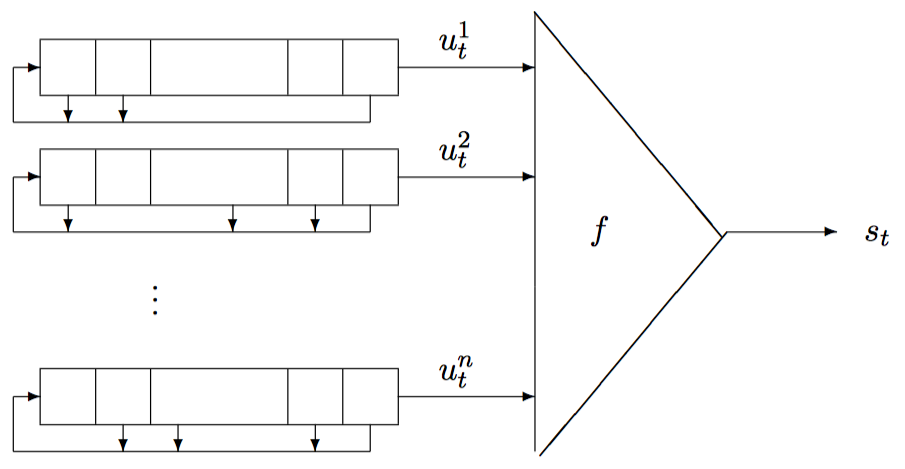
Geffe
Here we introduce the Geffe generator as an example. Geffe consists of 3 linear feedback shift registers, and the nonlinear combining function is:
F(x_1,x_2,x_3)=(x_1 \and x_2) \oplus (\urcorner x_1 \and x_3)=(x_1 \and x_2) \oplus ( x_1 \and x_3)\oplus x_3
2018 强网杯 (Qiangwang Cup) streamgame3
Let's briefly look at the challenge:
from flag import flag
assert flag.startswith("flag{")
assert flag.endswith("}")
assert len(flag)==24

def lfsr(R,mask):
    output = (R << 1) & 0xffffff
    i=(R&mask)&0xffffff
    lastbit=0
    while i!=0:
        lastbit^=(i&1)
        i=i>>1
    output^=lastbit
    return (output,lastbit)


def single_round(R1,R1_mask,R2,R2_mask,R3,R3_mask):
    (R1_NEW,x1)=lfsr(R1,R1_mask)
    (R2_NEW,x2)=lfsr(R2,R2_mask)
    (R3_NEW,x3)=lfsr(R3,R3_mask)
    return (R1_NEW,R2_NEW,R3_NEW,(x1*x2)^((x2^1)*x3))

R1=int(flag[5:11],16)
R2=int(flag[11:17],16)
R3=int(flag[17:23],16)
assert len(bin(R1)[2:])==17
assert len(bin(R2)[2:])==19
assert len(bin(R3)[2:])==21
R1_mask=0x10020
R2_mask=0x4100c
R3_mask=0x100002


for fi in range(1024):
    print fi
    tmp1mb=""
    for i in range(1024):
        tmp1kb=""
        for j in range(1024):
            tmp=0
            for k in range(8):
                (R1,R2,R3,out)=single_round(R1,R1_mask,R2,R2_mask,R3,R3_mask)
                tmp = (tmp << 1) ^ out
            tmp1kb+=chr(tmp)
        tmp1mb+=tmp1kb
    f = open("./output/" + str(fi), "ab")
    f.write(tmp1mb)
    f.close()
We can see that this program is very similar to a Geffe generator. Here we use the correlation attack method. We can compute the output of the Geffe-like generator for different combinations of three LFSR outputs, as shown below:
| x_1 | x_2 | x_3 | F(x_1,x_2,x_3) |
|---|---|---|---|
| 0 | 0 | 0 | 0 |
| 0 | 0 | 1 | 1 |
| 0 | 1 | 0 | 0 |
| 0 | 1 | 1 | 0 |
| 1 | 0 | 0 | 0 |
| 1 | 0 | 1 | 1 |
| 1 | 1 | 0 | 1 |
| 1 | 1 | 1 | 1 |
We can observe:
- The probability that the Geffe output matches x_1 is 0.75
- The probability that the Geffe output matches x_2 is 0.5
- The probability that the Geffe output matches x_3 is 0.75
This shows that the output has a very strong correlation with the first and third LFSRs. Therefore, we can brute-force enumerate the outputs of the first and third LFSRs and check the number of matches with the Geffe-like output. If it is approximately 75%, it can be considered correct. The second LFSR is then directly brute-forced.
The script is as follows:
#for x1 in range(2):
#    for x2 in range(2):
#        for x3 in range(2):
#            print x1,x2,x3,(x1*x2)^((x2^1)*x3)
#n = [17,19,21]

#cycle = 1
#for i in n:
#    cycle = cycle*(pow(2,i)-1)
#print cycle


def lfsr(R, mask):
    output = (R << 1) & 0xffffff
    i = (R & mask) & 0xffffff
    lastbit = 0
    while i != 0:
        lastbit ^= (i & 1)
        i = i >> 1
    output ^= lastbit
    return (output, lastbit)


def single_round(R1, R1_mask, R2, R2_mask, R3, R3_mask):
    (R1_NEW, x1) = lfsr(R1, R1_mask)
    (R2_NEW, x2) = lfsr(R2, R2_mask)
    (R3_NEW, x3) = lfsr(R3, R3_mask)
    return (R1_NEW, R2_NEW, R3_NEW, (x1 * x2) ^ ((x2 ^ 1) * x3))


R1_mask = 0x10020
R2_mask = 0x4100c
R3_mask = 0x100002
n3 = 21
n2 = 19
n1 = 17


def guess(beg, end, num, mask):
    ansn = range(beg, end)
    data = open('./output/0').read(num)
    data = ''.join(bin(256 + ord(c))[3:] for c in data)
    now = 0
    res = 0
    for i in ansn:
        r = i
        cnt = 0
        for j in range(num * 8):
            r, lastbit = lfsr(r, mask)
            lastbit = str(lastbit)
            cnt += (lastbit == data[j])
        if cnt > now:
            now = cnt
            res = i
            print now, res
    return res


def bruteforce2(x, z):
    data = open('./output/0').read(50)
    data = ''.join(bin(256 + ord(c))[3:] for c in data)
    for y in range(pow(2, n2 - 1), pow(2, n2)):
        R1, R2, R3 = x, y, z
        flag = True
        for i in range(len(data)):
            (R1, R2, R3,
             out) = single_round(R1, R1_mask, R2, R2_mask, R3, R3_mask)
            if str(out) != data[i]:
                flag = False
                break
        if y % 10000 == 0:
            print 'now: ', x, y, z
        if flag:
            print 'ans: ', hex(x)[2:], hex(y)[2:], hex(z)[2:]
            break


R1 = guess(pow(2, n1 - 1), pow(2, n1), 40, R1_mask)
print R1
R3 = guess(pow(2, n3 - 1), pow(2, n3), 40, R3_mask)
print R3
R1 = 113099
R3 = 1487603

bruteforce2(R1, R3)
The running result is as follows:
➜  2018-CISCN-start-streamgame3 git:(master) ✗ python exp.py
161 65536
172 65538
189 65545
203 65661
210 109191
242 113099
113099
157 1048576
165 1048578
183 1048580
184 1049136
186 1049436
187 1049964
189 1050869
190 1051389
192 1051836
194 1053573
195 1055799
203 1060961
205 1195773
212 1226461
213 1317459
219 1481465
239 1487603
1487603
now:  113099 270000 1487603
now:  113099 280000 1487603
now:  113099 290000 1487603
now:  113099 300000 1487603
now:  113099 310000 1487603
now:  113099 320000 1487603
now:  113099 330000 1487603
now:  113099 340000 1487603
now:  113099 350000 1487603
now:  113099 360000 1487603
ans:  1b9cb 5979c 16b2f3
Therefore the flag is flag{01b9cb05979c16b2f3}.
Challenges
- 2017 WHCTF Bornpig
- 2018 Google CTF 2018 Betterzip