Symbol Resolve
Basic Principles
When the linker processes object files, it needs to relocate certain positions in the object files, i.e., pointing symbols to the appropriate locations to ensure correct program execution. For example, when a program calls a function, the relevant call instruction must transfer control flow to the appropriate target execution address.
In ELF files, for each ELF section that requires relocation, there is a corresponding relocation table. For instance, if the .text section needs relocation, its corresponding relocation table is .rel.text.
As an example, when a program imports a function, .dynstr will contain the string of the corresponding function name, .dynsym will contain a symbol (Elf_Sym) with the corresponding name, and .rel.plt will contain a relocation entry pointing to this symbol. That is, the reference relationship between these is:
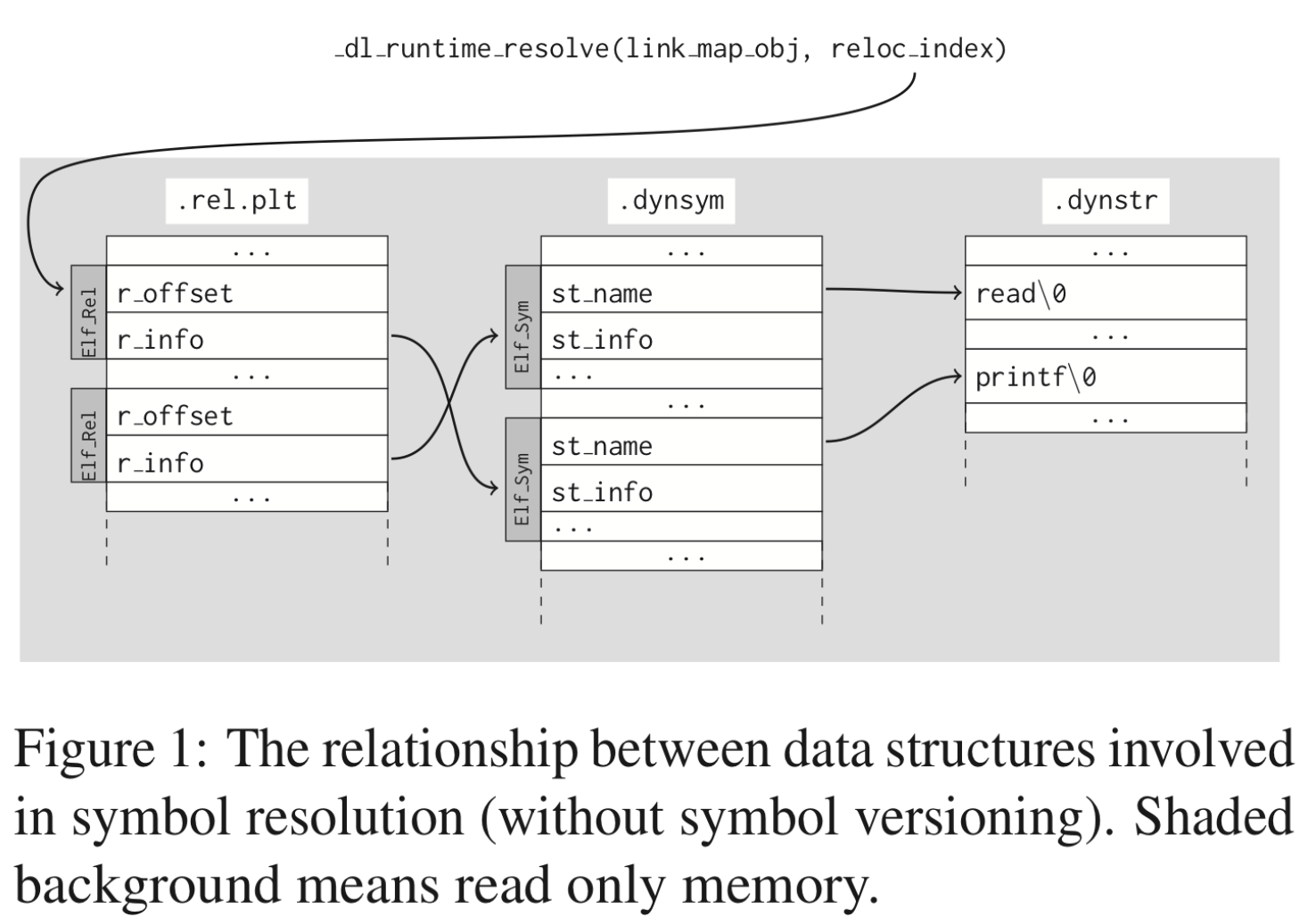
In summary, PLT entries mainly perform the following function call to resolve the target function:
_dl_runtime_resolve(link_map_obj, reloc_index)
Detailed Operations
_dl_runtime_resolve
The 32-bit and 64-bit versions have different _dl_runtime_resolve functions. The 32-bit version is as follows:
        .text
        .globl _dl_runtime_resolve
        .type _dl_runtime_resolve, @function
        cfi_startproc
        .align 16
_dl_runtime_resolve:
        cfi_adjust_cfa_offset (8)
        _CET_ENDBR
        pushl %eax                # Preserve registers otherwise clobbered.
        cfi_adjust_cfa_offset (4)
        pushl %ecx
        cfi_adjust_cfa_offset (4)
        pushl %edx
        cfi_adjust_cfa_offset (4)
        movl 16(%esp), %edx        # Copy args pushed by PLT in register.  Note
        movl 12(%esp), %eax        # that `fixup' takes its parameters in regs.
        call _dl_fixup                # Call resolver.
        popl %edx                # Get register content back.
        cfi_adjust_cfa_offset (-4)
        movl (%esp), %ecx
        movl %eax, (%esp)        # Store the function address.
        movl 4(%esp), %eax
        ret $12                        # Jump to function address.
        cfi_endproc
        .size _dl_runtime_resolve, .-_dl_runtime_resolve
Where:
- Lines starting with cfi are informational hints and can be ignored. See:
- _CET_ENDBR is related to Intel's CET (Control-flow Enforcement Technology), marking the position of indirect jumps. If an indirect jump target in the program does not have this instruction, problems will occur.
Therefore, this code can be simplified to:
        .text
        .globl _dl_runtime_resolve
        .type _dl_runtime_resolve, @function
        .align 16
_dl_runtime_resolve:
        pushl %eax                # Preserve registers otherwise clobbered.
        pushl %ecx
        pushl %edx
        movl 16(%esp), %edx        # Copy args pushed by PLT in register.  Note
        movl 12(%esp), %eax        # that `fixup' takes its parameters in regs.
        call _dl_fixup                # Call resolver.
        popl %edx                # Get register content back.
        movl (%esp), %ecx
        movl %eax, (%esp)        # Store the function address.
        movl 4(%esp), %eax
        ret $12                        # Jump to function address.
        .size _dl_runtime_resolve, .-_dl_runtime_resolve
That is, _dl_runtime_resolve saves the three registers eax, ecx, and edx, then places the address of link_map into eax and the offset of the symbol to be resolved into edx. Then it executes the _dl_fixup function. After the function returns, the following operations are performed in order:
- First, restore the value of the edx register
- Then, restore the value of ecx
- Then, place the return value of
_dl_fixuponto the current stack - Then, restore the value of eax
- Execute ret $12, at which point the stack contains:
- The address of the function to be resolved
- original eax
- The address of
link_map - reloc_offset
The 64-bit version of _dl_runtime_resolve is similar to the 32-bit version, with several key differences:
- Upon entering the function, more information is saved
- _dl_fixup uses rdi and rsi for parameter passing
- The target function is called using the jmp instruction at the end
        .globl _dl_runtime_resolve
        .hidden _dl_runtime_resolve
        .type _dl_runtime_resolve, @function
        .align 16
        cfi_startproc
_dl_runtime_resolve:
        cfi_adjust_cfa_offset(16) # Incorporate PLT
        _CET_ENDBR
# if DL_RUNTIME_RESOLVE_REALIGN_STACK
#  if LOCAL_STORAGE_AREA != 8
#   error LOCAL_STORAGE_AREA must be 8
#  endif
        pushq %rbx                        # push subtracts stack by 8.
        cfi_adjust_cfa_offset(8)
        cfi_rel_offset(%rbx, 0)
        mov %RSP_LP, %RBX_LP
        cfi_def_cfa_register(%rbx)
        and $-STATE_SAVE_ALIGNMENT, %RSP_LP
# endif
# ifdef REGISTER_SAVE_AREA
        sub $REGISTER_SAVE_AREA, %RSP_LP
#  if !DL_RUNTIME_RESOLVE_REALIGN_STACK
        cfi_adjust_cfa_offset(REGISTER_SAVE_AREA)
#  endif
# else
        # Allocate stack space of the required size to save the state.
#  if IS_IN (rtld)
        sub _rtld_local_ro+RTLD_GLOBAL_RO_DL_X86_CPU_FEATURES_OFFSET+XSAVE_STATE_SIZE_OFFSET(%rip), %RSP_LP
#  else
        sub _dl_x86_cpu_features+XSAVE_STATE_SIZE_OFFSET(%rip), %RSP_LP
#  endif
# endif
        # Preserve registers otherwise clobbered.
        movq %rax, REGISTER_SAVE_RAX(%rsp)
        movq %rcx, REGISTER_SAVE_RCX(%rsp)
        movq %rdx, REGISTER_SAVE_RDX(%rsp)
        movq %rsi, REGISTER_SAVE_RSI(%rsp)
        movq %rdi, REGISTER_SAVE_RDI(%rsp)
        movq %r8, REGISTER_SAVE_R8(%rsp)
        movq %r9, REGISTER_SAVE_R9(%rsp)
# ifdef USE_FXSAVE
        fxsave STATE_SAVE_OFFSET(%rsp)
# else
        movl $STATE_SAVE_MASK, %eax
        xorl %edx, %edx
        # Clear the XSAVE Header.
#  ifdef USE_XSAVE
        movq %rdx, (STATE_SAVE_OFFSET + 512)(%rsp)
        movq %rdx, (STATE_SAVE_OFFSET + 512 + 8)(%rsp)
#  endif
        movq %rdx, (STATE_SAVE_OFFSET + 512 + 8 * 2)(%rsp)
        movq %rdx, (STATE_SAVE_OFFSET + 512 + 8 * 3)(%rsp)
        movq %rdx, (STATE_SAVE_OFFSET + 512 + 8 * 4)(%rsp)
        movq %rdx, (STATE_SAVE_OFFSET + 512 + 8 * 5)(%rsp)
        movq %rdx, (STATE_SAVE_OFFSET + 512 + 8 * 6)(%rsp)
        movq %rdx, (STATE_SAVE_OFFSET + 512 + 8 * 7)(%rsp)
#  ifdef USE_XSAVE
        xsave STATE_SAVE_OFFSET(%rsp)
#  else
        xsavec STATE_SAVE_OFFSET(%rsp)
#  endif
# endif
        # Copy args pushed by PLT in register.
        # %rdi: link_map, %rsi: reloc_index
        mov (LOCAL_STORAGE_AREA + 8)(%BASE), %RSI_LP
        mov LOCAL_STORAGE_AREA(%BASE), %RDI_LP
        call _dl_fixup                # Call resolver.
        mov %RAX_LP, %R11_LP        # Save return value
        # Get register content back.
# ifdef USE_FXSAVE
        fxrstor STATE_SAVE_OFFSET(%rsp)
# else
        movl $STATE_SAVE_MASK, %eax
        xorl %edx, %edx
        xrstor STATE_SAVE_OFFSET(%rsp)
# endif
        movq REGISTER_SAVE_R9(%rsp), %r9
        movq REGISTER_SAVE_R8(%rsp), %r8
        movq REGISTER_SAVE_RDI(%rsp), %rdi
        movq REGISTER_SAVE_RSI(%rsp), %rsi
        movq REGISTER_SAVE_RDX(%rsp), %rdx
        movq REGISTER_SAVE_RCX(%rsp), %rcx
        movq REGISTER_SAVE_RAX(%rsp), %rax
# if DL_RUNTIME_RESOLVE_REALIGN_STACK
        mov %RBX_LP, %RSP_LP
        cfi_def_cfa_register(%rsp)
        movq (%rsp), %rbx
        cfi_restore(%rbx)
# endif
        # Adjust stack(PLT did 2 pushes)
        add $(LOCAL_STORAGE_AREA + 16), %RSP_LP
        cfi_adjust_cfa_offset(-(LOCAL_STORAGE_AREA + 16))
        # Preserve bound registers.
        PRESERVE_BND_REGS_PREFIX
        jmp *%r11                # Jump to function address.
        cfi_endproc
        .size _dl_runtime_resolve, .-_dl_runtime_resolve
#endif
_dl_fixup
The most core function executed in _dl_runtime_resolve is _dl_fixup, shown below (along with some related macros). Note that in 64-bit, reloc_arg is the reloc_index.
/* We use this macro to refer to ELF types independent of the native wordsize.
   `ElfW(TYPE)' is used in place of `Elf32_TYPE' or `Elf64_TYPE'.  */
#define ElfW(type) _ElfW(Elf, __ELF_NATIVE_CLASS, type)
#define _ElfW(e, w, t) _ElfW_1(e, w, _##t)
#define _ElfW_1(e, w, t) e##w##t

/* All references to the value of l_info[DT_PLTGOT],
  l_info[DT_STRTAB], l_info[DT_SYMTAB], l_info[DT_RELA],
  l_info[DT_REL], l_info[DT_JMPREL], and l_info[VERSYMIDX (DT_VERSYM)]
  have to be accessed via the D_PTR macro.  The macro is needed since for
  most architectures the entry is already relocated - but for some not
  and we need to relocate at access time.  */
#ifdef DL_RO_DYN_SECTION
#define D_PTR(map, i) ((map)->i->d_un.d_ptr + (map)->l_addr)
#else
#define D_PTR(map, i) (map)->i->d_un.d_ptr
#endif

#if (!ELF_MACHINE_NO_RELA && !defined ELF_MACHINE_PLT_REL) || ELF_MACHINE_NO_REL
#define PLTREL ElfW(Rela)
#else
#define PLTREL ElfW(Rel)
#endif

/* The type of the return value of fixup/profile_fixup.  */
#define DL_FIXUP_VALUE_TYPE ElfW(Addr)
/* Construct a value of type DL_FIXUP_VALUE_TYPE from a code address
   and a link map.  */
#define DL_FIXUP_MAKE_VALUE(map, addr) (addr)
/* Extract the code address from a value of type DL_FIXUP_MAKE_VALUE.
 */
#define DL_FIXUP_VALUE_CODE_ADDR(value) (value)
#define DL_FIXUP_VALUE_ADDR(value) (value)
#define DL_FIXUP_ADDR_VALUE(addr) (addr)

/* Result of the lookup functions and how to retrieve the base address.  */
typedef struct link_map *lookup_t;
#define LOOKUP_VALUE(map) map
#define LOOKUP_VALUE_ADDRESS(map, set) ((set) || (map) ? (map)->l_addr : 0)
/* Calculate the address of symbol REF using the base address from map MAP,
   if non-NULL.  Don't check for NULL map if MAP_SET is TRUE.  */
#define SYMBOL_ADDRESS(map, ref, map_set)                                                                  \
    ((ref) == NULL ? 0                                                                                     \
                   : (__glibc_unlikely((ref)->st_shndx == SHN_ABS) ? 0                                     \
                                                                    : LOOKUP_VALUE_ADDRESS(map, map_set)) + \
                         (ref)->st_value)

#ifndef reloc_offset
#define reloc_offset reloc_arg
#define reloc_index reloc_arg / sizeof(PLTREL)
#endif
/* This function is called through a special trampoline from the PLT the
   first time each PLT entry is called.  We must perform the relocation
   specified in the PLT of the given shared object, and return the resolved
   function address to the trampoline, which will restart the original call
   to that address.  Future calls will bounce directly from the PLT to the
   function.  */
DL_FIXUP_VALUE_TYPE
attribute_hidden __attribute((noinline)) ARCH_FIXUP_ATTRIBUTE
_dl_fixup(
#ifdef ELF_MACHINE_RUNTIME_FIXUP_ARGS
    ELF_MACHINE_RUNTIME_FIXUP_ARGS,
#endif
    struct link_map *l, ElfW(Word) reloc_arg)
{
    // Get the dynamic symbol table of the target file
    const ElfW(Sym) *const symtab = (const void *)D_PTR(l, l_info[DT_SYMTAB]);
    // Get the dynamic string table of the target file
    const char *strtab = (const void *)D_PTR(l, l_info[DT_STRTAB]);
    // Get the relocation entry to be processed based on the given offset
    const PLTREL *const reloc = (const void *)(D_PTR(l, l_info[DT_JMPREL]) + reloc_offset);
    // Get the symbol information of the symbol to be resolved based on the relocation entry
    const ElfW(Sym) *sym = &symtab[ELFW(R_SYM)(reloc->r_info)];
    const ElfW(Sym) *refsym = sym;
    // rel_addr ultimately stores the address of the symbol to be resolved
    // i.e., *rel_addr = addr_of_symbol_to_be_resolved
    void *const rel_addr = (void *)(l->l_addr + reloc->r_offset);
    lookup_t result;
    DL_FIXUP_VALUE_TYPE value;
    /* Sanity check that we're really looking at a PLT relocation.  */
    // Ensure the type of the relocation entry is ELF_MACHINE_JMP_SLOT
    assert(ELFW(R_TYPE)(reloc->r_info) == ELF_MACHINE_JMP_SLOT);
    /* Look up the target symbol.  If the normal lookup rules are not
      used don't look in the global scope.  */
    // Check the visibility of the symbol
    if (__builtin_expect(ELFW(ST_VISIBILITY)(sym->st_other), 0) == 0)
    {
        // Get the version information of the symbol
        const struct r_found_version *version = NULL;
        if (l->l_info[VERSYMIDX(DT_VERSYM)] != NULL)
        {
            const ElfW(Half) *vernum = (const void *)D_PTR(l, l_info[VERSYMIDX(DT_VERSYM)]);
            ElfW(Half) ndx = vernum[ELFW(R_SYM)(reloc->r_info)] & 0x7fff;
            version = &l->l_versions[ndx];
            if (version->hash == 0)
                version = NULL;
        }
        /* We need to keep the scope around so do some locking.  This is
         not necessary for objects which cannot be unloaded or when
         we are not using any threads (yet).  */
        int flags = DL_LOOKUP_ADD_DEPENDENCY;
        if (!RTLD_SINGLE_THREAD_P)
        {
            THREAD_GSCOPE_SET_FLAG();
            flags |= DL_LOOKUP_GSCOPE_LOCK;
        }
#ifdef RTLD_ENABLE_FOREIGN_CALL
        RTLD_ENABLE_FOREIGN_CALL;
#endif
        // Look up the link_map of the target file where the symbol to be resolved resides
        result = _dl_lookup_symbol_x(strtab + sym->st_name, l, &sym, l->l_scope,
                                     version, ELF_RTYPE_CLASS_PLT, flags, NULL);
        /* We are done with the global scope.  */
        if (!RTLD_SINGLE_THREAD_P)
            THREAD_GSCOPE_RESET_FLAG();
#ifdef RTLD_FINALIZE_FOREIGN_CALL
        RTLD_FINALIZE_FOREIGN_CALL;
#endif
        /* Currently result contains the base load address (or link map)
         of the object that defines sym.  Now add in the symbol
         offset.  */
        // Calculate the absolute address of the symbol based on the found link_map: result->l_addr + sym->st_value
        // l_addr is the base address of the file where the function to be resolved resides
        value = DL_FIXUP_MAKE_VALUE(result,
                                    SYMBOL_ADDRESS(result, sym, false));
    }
    else
    {
        /* We already found the symbol.  The module (and therefore its load
         address) is also known.  */
        value = DL_FIXUP_MAKE_VALUE(l, SYMBOL_ADDRESS(l, sym, true));
        result = l;
    }
    /* And now perhaps the relocation addend.  */
    value = elf_machine_plt_value(l, reloc, value);
    if (sym != NULL && __builtin_expect(ELFW(ST_TYPE)(sym->st_info) == STT_GNU_IFUNC, 0))
        value = elf_ifunc_invoke(DL_FIXUP_VALUE_ADDR(value));
    /* Finally, fix up the plt itself.  */
    // Fix up the PLT table
    if (__glibc_unlikely(GLRO(dl_bind_not)))
        return value;
    return elf_machine_fixup_plt(l, result, refsym, sym, reloc, rel_addr, value);
}

static inline ElfW(Addr)
elf_machine_fixup_plt (struct link_map *map, lookup_t t,
                       const ElfW(Sym) *refsym, const ElfW(Sym) *sym,
                       const ElfW(Rela) *reloc,
                       ElfW(Addr) *reloc_addr, ElfW(Addr) value)
{
  return *reloc_addr = value;
}
/* Return the final value of a PLT relocation.  On x86-64 the
   JUMP_SLOT relocation ignores the addend.  */
static inline ElfW(Addr)
elf_machine_plt_value (struct link_map *map, const ElfW(Rela) *reloc,
                       ElfW(Addr) value)
{
  return value;
}