Audio Steganography
Audio-related CTF challenges mainly use steganography strategies, primarily including MP3 steganography, LSB steganography, waveform steganography, spectrum steganography, and more.
Common Techniques
Information that can be discovered through binwalk and strings will not be discussed in detail here.
MP3 Steganography
Principle
MP3 steganography mainly uses the Mp3Stego tool. Its basic introduction and usage are as follows:
MP3Stego will hide information in MP3 files during the compression process. The data is first compressed, encrypted and then hidden in the MP3 bit stream.
encode -E hidden_text.txt -P pass svega.wav svega_stego.mp3
decode -X -P pass svega_stego.mp3
Example
ISCC-2016: Music Never Sleep
After initial observation, strings reveals nothing, and listening to the audio shows no abnormalities, suggesting that steganography software was used to hide data.

After obtaining the password, use Mp3Stego to decrypt.
decode.exe -X ISCC2016.mp3 -P bfsiscc2016
The resulting file iscc2016.mp3.txt:
Flag is SkYzWEk0M1JOWlNHWTJTRktKUkdJTVpXRzVSV0U2REdHTVpHT1pZPQ== ???
After Base64 && Base32 decoding, we get the flag.
Waveform
Principle
Typically, for waveform-related challenges, after observing anomalies, use relevant software (Audacity, Adobe Audition, etc.) to observe waveform patterns and further convert the waveform into 01 strings, etc., to extract and convert the final flag.
Example
ISCC-2017: Misc-04
Actually, the hidden information is in the very beginning of the audio. If you don't listen carefully, you might mistake it for steganography software.

Using high as 1 and low as 0, convert to a 01 string.
110011011011001100001110011111110111010111011000010101110101010110011011101011101110110111011110011111101
Convert to ASCII and decrypt the Morse code to get the flag.
Note
Some more complex challenges may first perform a series of processing on the audio, such as filtering. For example, JarvisOJ - Voice of God Writeup
Spectrum
Principle
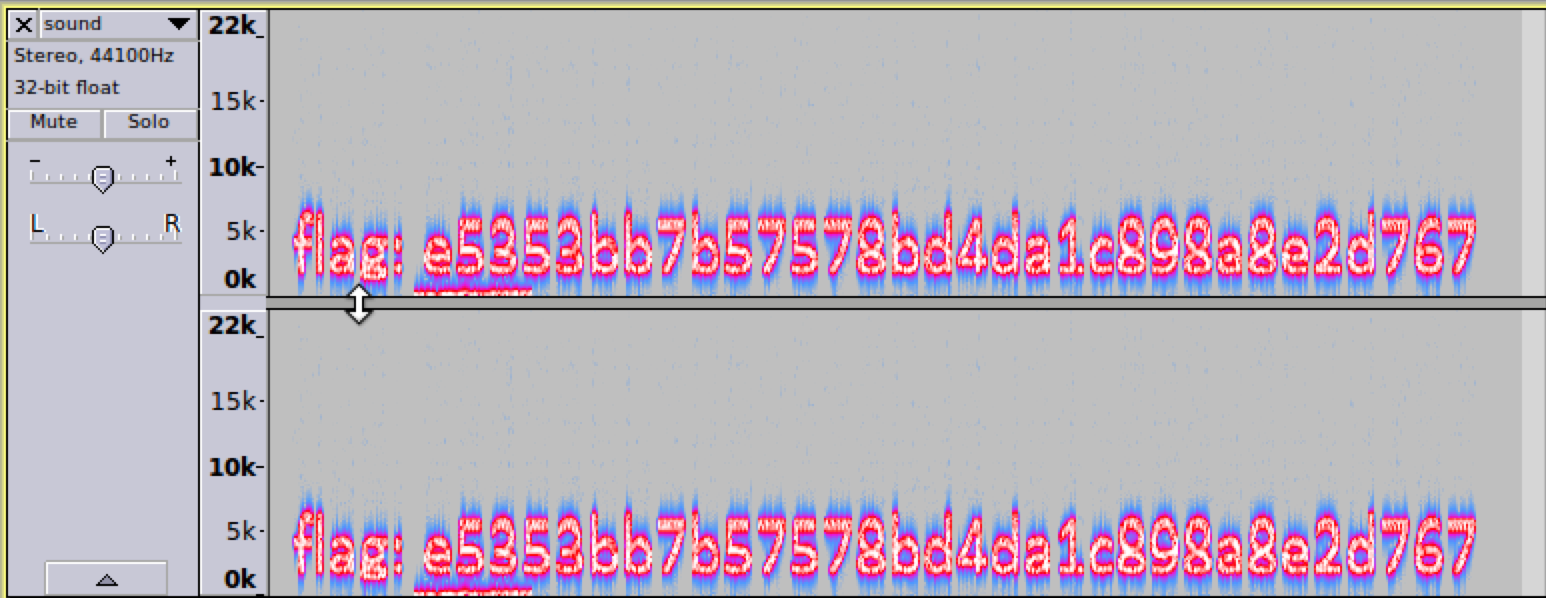
Spectrum steganography in audio hides strings in the frequency spectrum. Such audio usually has an obvious characteristic — it sounds like noise or is rather harsh.
Example
Su-ctf-quals-2014:hear_with_your_eyes
LSB Audio Steganography
Principle
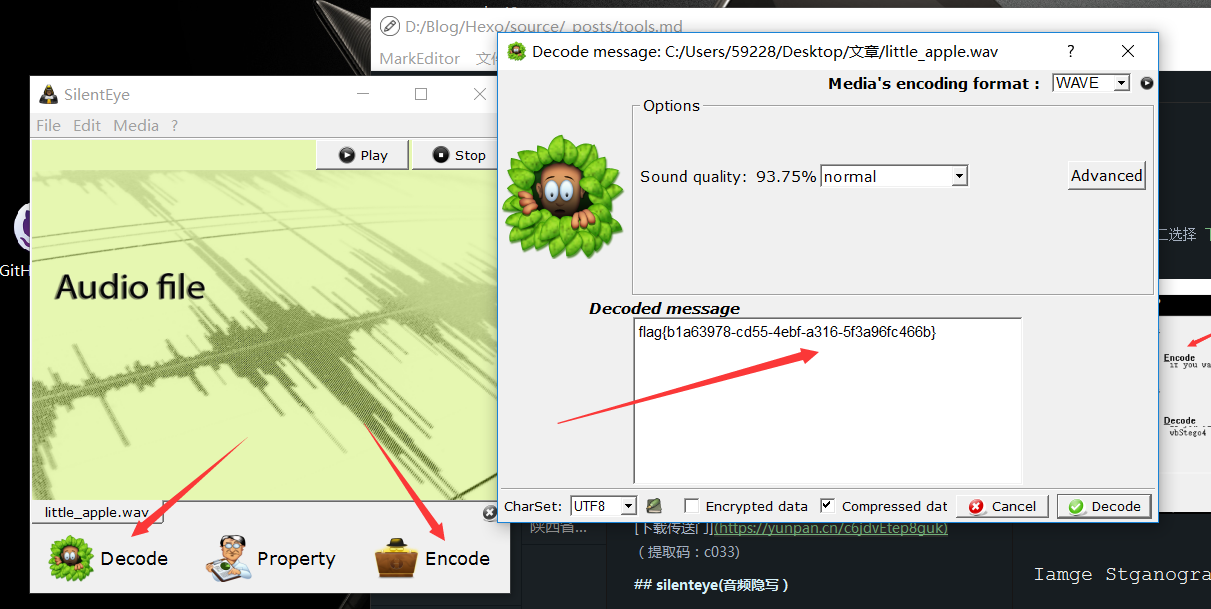
Similar to LSB steganography in image steganography, there is also corresponding LSB steganography in audio. The main tool used is Silenteye, which is introduced as follows:
SilentEye is a cross-platform application design for an easy use of steganography, in this case hiding messages into pictures or sounds. It provides a pretty nice interface and an easy integration of new steganography algorithm and cryptography process by using a plug-ins system.
Example
2015 Guangdong Province Qiangwang Cup - Little Apple
Simply use silenteye directly.