Mutable Heap Numbers
The Mutable Heap Numbers mechanism is an optimization mechanism publicly disclosed by the V8 team in 2025. The idea originated from a performance bottleneck of Math.random in async-fs, a JS filesystem implementation. For example, consider the following code:
let seed;
Math.random = (function() {
  return function () {
    seed = ((seed + 0x7ed55d16) + (seed << 12))  & 0xffffffff;
    seed = ((seed ^ 0xc761c23c) ^ (seed >>> 19)) & 0xffffffff;
    seed = ((seed + 0x165667b1) + (seed << 5))   & 0xffffffff;
    seed = ((seed + 0xd3a2646c) ^ (seed << 9))   & 0xffffffff;
    seed = ((seed + 0xfd7046c5) + (seed << 3))   & 0xffffffff;
    seed = ((seed ^ 0xb55a4f09) ^ (seed >>> 16)) & 0xffffffff;
    return (seed & 0xfffffff) / 0x10000000;
  };
})();
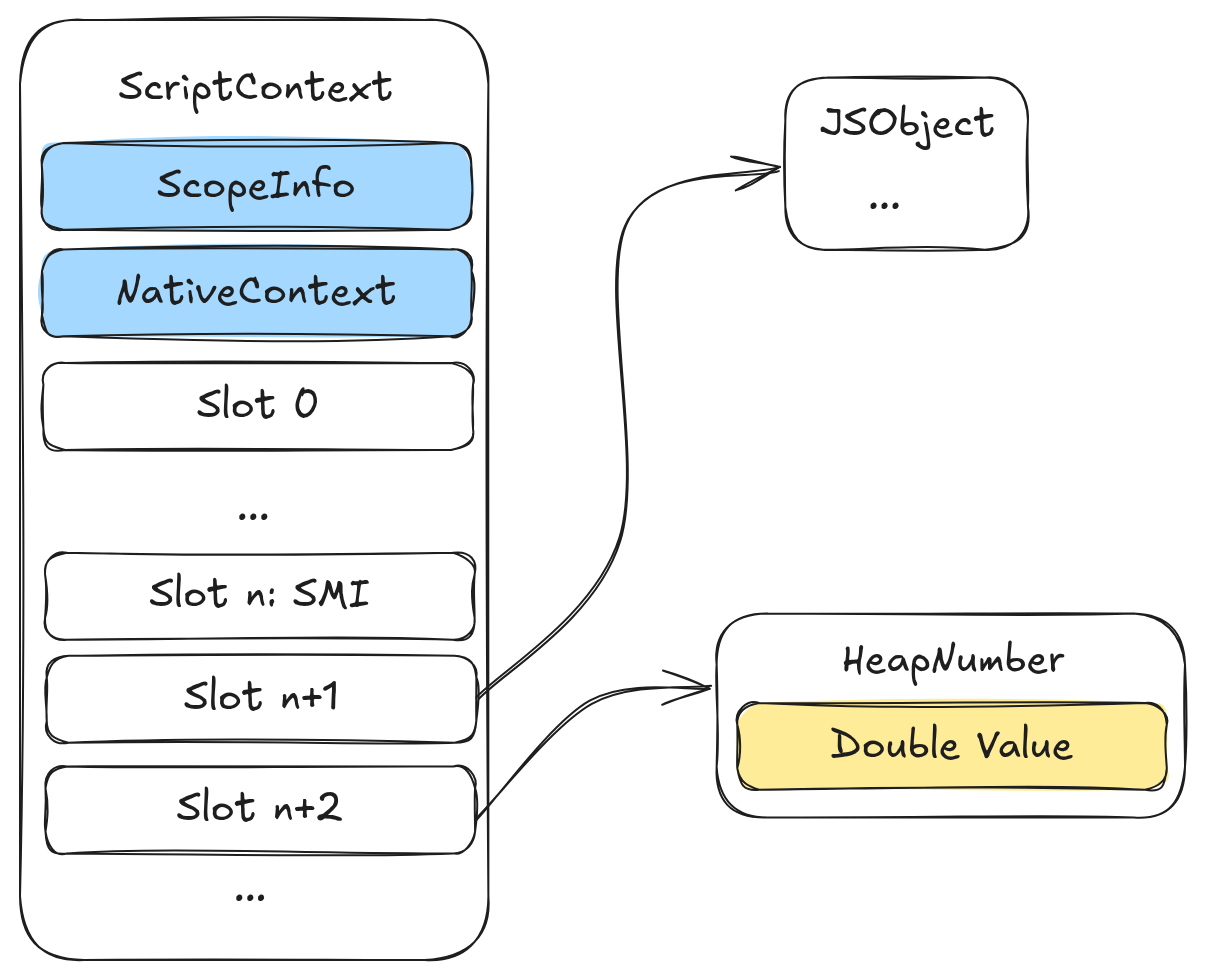
The variable seed changes with every call to Math.random, generating a pseudo-random sequence. The key point is that seed is stored in a ScriptContext, a structure used to represent the storage location of accessible values within a specific script (in plain terms, the context of a JS script). Internally, this structure is an array of V8 tagged values:
- ScopeInfo: context metadata.
- NativeContext: global object.
- Slot 0 ~ Slot n: various other values.
The values of these Slots are typically 32 bits, with the least significant bit of each value used as a tag, so when used, the value is right-shifted by 1 bit:
- 0: 31-bit small integer (SMI).
- 1: 31-bit pointer.
Correspondingly, data larger than 31 bits is stored on the heap, with the ScriptContext's Slot storing pointers to these objects. For simple numeric types, a HeapNumber object is used for storage, while complex objects use structures like JSObject.
This is where the bottleneck arises:
- HeapNumber allocation: In the JS code above, the
seedvariable is stored in aHeapNumberobject, so memory allocation and deallocation occurs with everyMath.randomfunction call. - Floating-point arithmetic: Although
Math.randomuses integer operations throughout,seedis stored in a genericHeapNumber, causing the compiler to generate slower floating-point operation instructions, as well as requiring potential 64-bit floating-point to 32-bit integer conversions and precision loss checks even when the compiler knows it might be a 32-bit integer.
How to break through? The V8 team adopted a two-part optimization:
- Slot type tracking / mutable heap number slots: The V8 team extended script context const value tracking to include type information, tracking whether a slot value is a constant,
SMI,HeapNumber, or generic tagged value. They introduced the concept of mutable heap numbers in script contexts, similar to mutable heap number fields ofJSObjects: the slot value changed from pointing to a changingHeapNumberto holding a HeapNumber — thereby eliminating heap reallocation during code optimization updates. - Mutable heap Int32: The V8 team enhanced script context slot types to track whether a numeric value is within the Int32 range. If so, the
HeapNumberstores it as a pureInt32; if it needs to be extended todouble, no reallocation ofHeapNumberspace is needed. In this case, theMath.randomin the example above, under compiler observation, is known to be a continuously updated integer value, so the corresponding slot is marked as a mutableInt32.
Note that such optimization introduces code dependencies on the context slot's value. If the slot's type changes (e.g., becomes a string), the optimization will be rolled back. Therefore, ensuring slot type stability is crucial (in other words, don't keep changing the type of a JS variable).
Ultimately, the optimization results for Math.random are as follows:
- No allocation / fast in-place updates: Updating
seeddoes not require repeatedly allocating new heap objects. - Integer operations: The compiler knows the type is
Int32, thus avoiding generating inefficient floating-point operations.
In the end, the async-fs benchmark speed improved by 2.5x, and the overall score on JetStream2 improved by approximately 1.6% — quite an effective result.