KPTI - Kernel Page Table Isolation
Introduction
The initial main purpose of the KPTI mechanism was to mitigate KASLR bypasses and CPU side-channel attacks.
In the KPTI mechanism, the isolation between kernel-space memory and user-space memory is further enhanced.
- The page table in kernel mode includes page tables for both user-space memory and kernel-space memory.
- The page table in user mode only includes page tables for user-space memory and the necessary kernel-space memory page tables, such as memory used for handling system calls, interrupts, and other information.
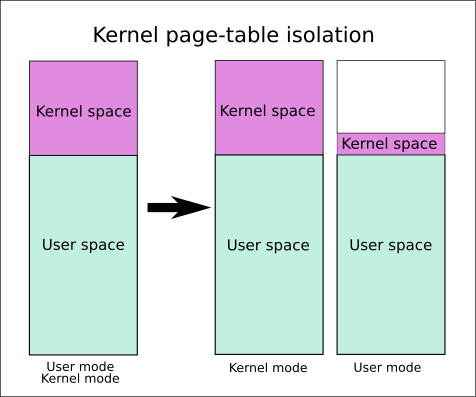
In the x86_64 PTI mechanism, the user-space memory mapping portion in kernel mode is entirely marked as non-executable. This means that hardware that previously did not have the SMEP feature will have a feature similar to SMEP if KPTI protection is enabled. Additionally, SMAP emulation can also be introduced in a similar way, but it has not been introduced yet. Therefore, in kernels with KPTI protection enabled, if SMAP protection is not enabled, the kernel can still access user-space memory, but it cannot jump to user-space to execute shellcode.
KPTI was introduced in Linux 4.15 and was backported to Linux 4.14.11, 4.9.75, and 4.4.110.
Development History
TODO.
Implementation
TODO.
Enabling and Disabling
If using a kernel started with qemu, we can add kpti=1 to the -append option to enable KPTI.
If using a kernel started with qemu, we can add nopti to the -append option to disable KPTI.
Status Check
We can check whether the KPTI mechanism is enabled through the following two methods.
/home/pwn # dmesg | grep 'page table'
[    0.000000] Kernel/User page tables isolation: enabled
/home/pwn # cat /proc/cpuinfo | grep pti
fpu_exception   : yes
flags           : ... pti smep smap
Attack KPTI
The KPTI mechanism is different from SMAP and SMEP. Since it is tightly integrated with the source code, it seems impossible to disable at runtime.
Modify Page Tables
After KPTI is enabled, all data in user-space is marked with NX permissions. However, we can consider modifying the corresponding page table permissions to grant executable permissions. When the kernel does not have smep enabled, after modifying the page table permissions, we can return to user mode and execute user-space code.
SWITCH_TO_USER_CR3_STACK
After the KPTI mechanism is enabled, a page table switch occurs when transitioning from user mode to kernel mode; a page table switch also occurs when returning from kernel mode to user mode. Therefore, if we can control the kernel to execute the page table switching code snippet that runs when returning to user mode, we can normally return to user mode.
By analyzing the code for switching from kernel mode to user mode, we can learn that the page table switch mainly relies on the SWITCH_TO_USER_CR3_STACK assembly macro. Therefore, we just need to be able to call this code.
.macro SWITCH_TO_USER_CR3_STACK scratch_reg:req
    pushq   %rax
    SWITCH_TO_USER_CR3_NOSTACK scratch_reg=\scratch_reg scratch_reg2=%rax
    popq    %rax
.endm
.macro SWITCH_TO_USER_CR3_NOSTACK scratch_reg:req scratch_reg2:req
    ALTERNATIVE "jmp .Lend_\@", "", X86_FEATURE_PTI
    mov %cr3, \scratch_reg

    ALTERNATIVE "jmp .Lwrcr3_\@", "", X86_FEATURE_PCID

    /*
     * Test if the ASID needs a flush.
     */
    movq    \scratch_reg, \scratch_reg2
    andq    $(0x7FF), \scratch_reg      /* mask ASID */
    bt  \scratch_reg, THIS_CPU_user_pcid_flush_mask
    jnc .Lnoflush_\@

    /* Flush needed, clear the bit */
    btr \scratch_reg, THIS_CPU_user_pcid_flush_mask
    movq    \scratch_reg2, \scratch_reg
    jmp .Lwrcr3_pcid_\@

.Lnoflush_\@:
    movq    \scratch_reg2, \scratch_reg
    SET_NOFLUSH_BIT \scratch_reg

.Lwrcr3_pcid_\@:
    /* Flip the ASID to the user version */
    orq $(PTI_USER_PCID_MASK), \scratch_reg

.Lwrcr3_\@:
    /* Flip the PGD to the user version */
    orq     $(PTI_USER_PGTABLE_MASK), \scratch_reg
    mov \scratch_reg, %cr3
.Lend_\@:
.endm
In fact, we not only want to switch page tables, but also want to return to user mode. Therefore, we also need to reuse the code in the kernel that returns to user mode. There are two main ways the kernel returns to user mode: iret and sysret. Details are described below.
iret
SYM_INNER_LABEL(swapgs_restore_regs_and_return_to_usermode, SYM_L_GLOBAL)
#ifdef CONFIG_DEBUG_ENTRY
    /* Assert that pt_regs indicates user mode. */
    testb   $3, CS(%rsp)
    jnz 1f
    ud2
1:
#endif
    POP_REGS pop_rdi=0

    /*
     * The stack is now user RDI, orig_ax, RIP, CS, EFLAGS, RSP, SS.
     * Save old stack pointer and switch to trampoline stack.
     */
    movq    %rsp, %rdi
    movq    PER_CPU_VAR(cpu_tss_rw + TSS_sp0), %rsp
    UNWIND_HINT_EMPTY

    /* Copy the IRET frame to the trampoline stack. */
    pushq   6*8(%rdi)   /* SS */
    pushq   5*8(%rdi)   /* RSP */
    pushq   4*8(%rdi)   /* EFLAGS */
    pushq   3*8(%rdi)   /* CS */
    pushq   2*8(%rdi)   /* RIP */

    /* Push user RDI on the trampoline stack. */
    pushq   (%rdi)

    /*
     * We are on the trampoline stack.  All regs except RDI are live.
     * We can do future final exit work right here.
     */
    STACKLEAK_ERASE_NOCLOBBER

    SWITCH_TO_USER_CR3_STACK scratch_reg=%rdi

    /* Restore RDI. */
    popq    %rdi
    SWAPGS
    INTERRUPT_RETURN
As we can see, by forging the following stack and jumping to movq %rsp, %rdi, we can both switch page tables and return to user mode.
fake rax
fake rdi
RIP
CS
EFLAGS
RSP
SS
sysret
When using sysret, we first need to ensure that rcx and r11 have the following values:
rcx, save the rip of the code to be executed when returning to userspace
r11, save eflags
Then construct the following stack:
fake rdi
rsp, the stack of the userspace
Finally, jump to the following code in entry_SYSCALL_64 to return to user mode.
    SWITCH_TO_USER_CR3_STACK scratch_reg=%rdi

    popq    %rdi
    popq    %rsp
    swapgs
    sysretq
signal handler
We can also consider registering a signal handler in user mode to execute code located in user space. With this approach, we do not need to switch page tables.