ESP Law Method
The ESP Law method is a powerful tool for unpacking and one of the most frequently used unpacking methods.
Key Points
The principle of the ESP Law is to leverage the stack balance in a program to quickly find the OEP.
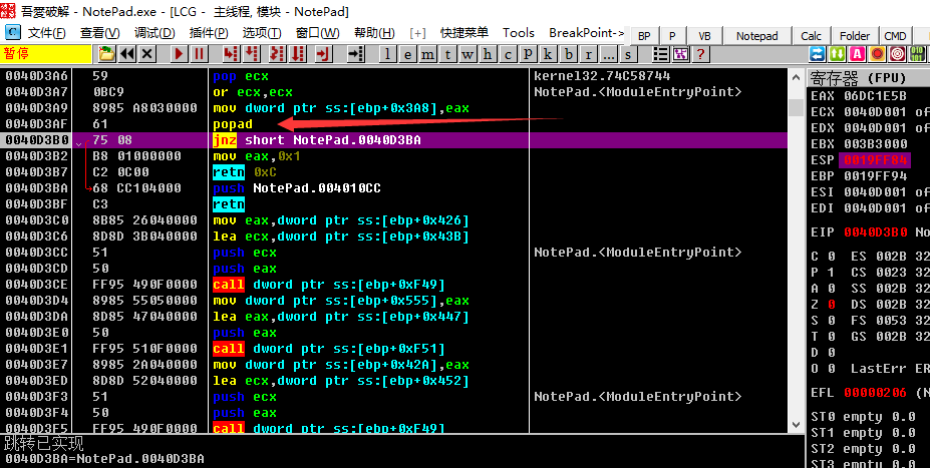
During the self-decryption or self-decompression process of a program, many packers first push the current register states onto the stack, for example using pushad, and after decompression is complete, pop the previous register values, for example using popad. Therefore, when the registers are popped, the program code is usually restored, and at that point the hardware breakpoint triggers. Then, from the program's current position, only a few single-step operations are needed to easily reach the correct OEP location.
- The program starts with
pushad/pushfdright after being loaded - After all registers are pushed onto the stack, set a hardware breakpoint on the ESP register
- Run the program and trigger the breakpoint
- Delete the hardware breakpoint and begin analysis
Example
The sample program can be downloaded here: 2_esp.zip
Using the same example as the previous section, the entry point starts with a pushad. We press F8 to execute pushad to save the register state. In the register window on the right, we can see that the value of the ESP register has turned red, indicating that its value has changed.
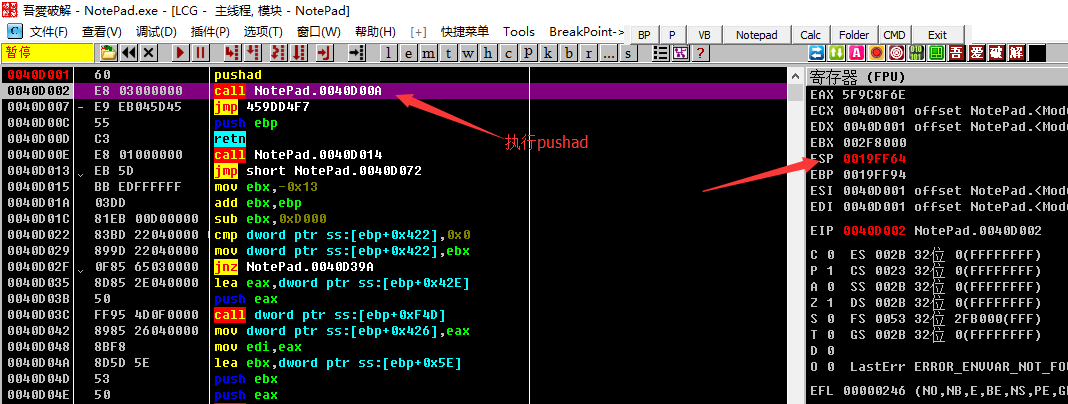
We right-click on the value of the ESP register, which is 0019FF64 in the figure, and select HW break[ESP]. Then we press F9 to run the program, and the program will break when the breakpoint is triggered. As shown in the figure, we arrive at position 0040D3B0. This is the same position we reached through single-step tracing in the previous section, so we won't go into further detail.